We have had not a drop of wind for 12 hours.
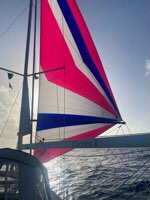
Early yesterday, we had about 7 to 10 kn of wind and we flew the BWR. It converted to approximately 4 kn of sailing, in roughly the right direction. Unfortunately, there was insufficient wind to keep the sails full, and they would regularly collapse, and refill with a gunshot type retort. In one of my physics lessons, I’m sure my teacher told me that there was no such thing as a free bang; the energy created would have to be dissipated somewhere. In our case, it would be stretching or tearing of the sail, damage to the running rigging, (the sheets or ropes holding the sails out), or to the standing rigging, (the mast, boom, and wires holding it all up). Yesterday it manifested in damage to the sheets! We have had to cut 3 meters of the port sheet, and 10 cm of the starboard sheet due to chafing and debriding of the outer cover. One of the things we have in abundance it appears is chafe!
When we brought the sail in to effect repairs to the sheets, the winds departed entirely, so the iron donkey was deployed!
Carioca is fitted with a Gori three blade folding propeller. This is a very clever piece of kit, which allows the pitch of the propeller blades to be changed to give more torque, less noise, and greater range for the engine. It also folds away when sailing, reducing drag, and stops turning the shaft and gears. It is used for long distance passages, and is called Overdrive. It is better not to be in overdrive when manoeuvering around a marina, when speed of response is more important, but it is vital for economy to engage it for long passages. Unfortunately the only way to engage overdrive is to ensure that the vessel is moving astern, with water flowing over the propeller, and then moving quickly to forward; it’s a bit of a knack to get it right, as there is no indication other than the noise the engine makes, or the fact that certain speeds are reached at lower revs, that overdrive has been engaged. It felt odd going backwards in 1 m swells, mid Atlantic, as the pointy bit of the boat is better suited to cutting through the water than the blunt back bit.
I mention this as the latest forecasts indicate that the wind hole may well extend for the rest of our passage. There is a very large low, mid Atlantic, and the associated high-pressure is blocking the trade winds, our way of heading west. Current indications are that our path will be affected by this right through until next weekend. With winds below 8 kn, it’s extremely difficult to sail (see above) and so we have had to resign ourselves to a considerable amount of motoring.
The question is, what are the optimal revs to maximise range? Anyone?!!
When I bought the boat, it came with four lever arch files of manuals for all of the equipment and systems on board including the propeller and engine (actually, if Mr Rassey is reading, the manual is pants unlike your boats!). Unfortunately nowhere is there a range optimisation table in the manual! I had in my mind that when I was purchasing a Halberg Rassy, I saw on their website a table setting out various fuel efficiencies relative to speeds. Whilst I am able to send emails and pictures (I’m not sure of the picture quality) and receive emails, unfortunately satellite technology does not permit website browsing as it would onshore, unless you want to pay £5000 for the hardware and £500 for a monthly subscription, which I did not! So a Google search for me requires me to put the question in an email to a friend and await their response!
Nigel very kindly sourced the table for me which revealed that, to obtain maximum range, we need to be running at 1000 revs, which should convert to 3.2 kn, using 1.5 L of diesel per hour, giving a range of 757nm. Until we heard from Nigel we were running at 1500 rpm giving us 5-6 kn but we couldn’t know the fuel usage or range. It turns out to have been 3.2 lph with a range of 621m. That’s too much fuel, so we throttled back to 1300 rpm which will hopefully extend the range to 680m giving us 4.6 kns. These figures are all approximate, as they do depend on whether or not the hull of the vessel is clean, and the way in which it is laden. If it is excessively heavy in the bow or stern, then not all of the fuel in the tanks will be capable of being pumped out, and obviously the heavier the boat, the slower it will be. It is a judgment call, however, as to whether we think there will be any wind in the coming days, and we have banked on there being at least 48 hours of sailing which, together with the 680 mile range in the tanks, will get us over the line. If in another few days, we have not managed any sailing, then we may need to throttle back even further to extend the range.
Not what we were hoping for. The various predictions are putting our arrival back even further. I can almost taste the rum punch, but it seems the wind gods are playing games with us!!
I did another Google search, this time via Sue, as to whether or not chlorine will act as a degreasing agent, to assist in the removal some of the residue of oil in the bilges. The bilges on board Carioca were previously spotless, and yesterday when we inspected them there was still a residue of oil. This will inevitably deteriorate and become malodorous, and it’s important, therefore, to keep the bilges clean and as dry as possible. We have lots of chlorine on board (anti-orca measures) and I wondered whether we could swirl that in the bilges to neutralise the oil. Sue reported that Google says “chlorine can react, at times explosively, with a number of organic materials such as oil and grease…….”, and so probably wise not to deploy that technique! When we get to Saint Lucia, I will buy some specific degreaser. I became very familiar with its qualities when refitting Dreamer. Swafega degreaser worked absolute wonders, and hopefully I’ll be able to get some of that.
So apart from gentle motoring along at 3 to 4 kn, we’ve been sunbathing, reading, sleeping, and cooking. Today we converted our mahi-mahi to a wonderful Thai curry, which was lovely and spicy. We added some new potatoes (from our bank of tins). We still have five or six fresh onions(if you take the stalk out of the middle!), a few cloves of garlic and some sad looking spring onions, oh and 4 oranges.
Here’s hoping for some wind!


 Carioca Sailing
Leave a comment