Choosing the boat
Hal Roth wrote a very readable book, “How to sail around the world”. For every aspect of the endeavour, there are very practical tips. Everything is presented ‘black or white’ leaving the reader in no doubt as his opinion on the best solution. His advice on choice of boat was simple: the length should be between 38 and 45 foot. Any shorter and the extra weight associated with a live-aboard would make the boat float too low in the water compared to what the designer intended. Any longer and you would be ‘at the wrong end of the bay’, drawing too much draught, mixing with the larger boats with professional skippers and missing out on the interaction with more well-heeled, like-minded sailors which is such an intearal part of the adventure. His book dates from the 90’s and, today, some might extend the upper length. On a recent gullet holiday in Turkey, there was no doubt that the average size of the yachts had increased to 55ft. But I took on-board the advice as to size as a key part of the selection criteria. The other factor is availability of marina berths in the UK. Anything over 50ft and it would be difficult to find a berth on our return.
There are an endless list of possible selection criteria for a boat (material for the hull, is a skeg rudder essential, size of tanks, etc). How much will a boat cost? That is like asking, “How long is a piece of string”. We had decided to look at monohulls only. The budget was set in part by the sale proceeds of Dreamer, which sold in a matter of weeks, with a bidding war taking place! The boat market in 2022 was slightly surreal, with brokers complaining of lack of stock and new build dates being pushed back to 2024/5. It took us only 4 months to find and purchase a boat. Our initial budget was unrealistic and the boats we were looking at would not have been up to the task. Nor did we have the time to invest to allow a ‘budget solution’ and repeat the refit exercise.
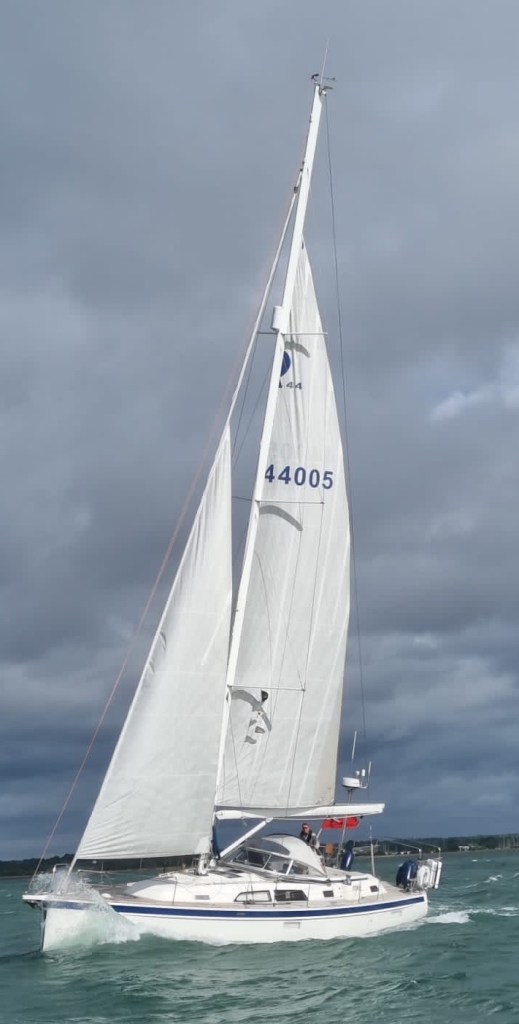
So how did we choose Carioca?
1. We wanted a ‘top end’ brand. Hallberg Rassey has heritage and build boats ‘properly’.
2. We wanted a boat that was both comfortable and sailed well. Carioca is a German Frers design (they have designed many top end boats). She is one of the fastest HR boats ever built. It is a fact that a microwave, dishwasher, washing machine and fridge and freezer make living aboard a much more pleasurable experience and Carioca has all of them!
3. Carioca had belonged to a highly experienced owner. The boat was ‘sorted’ and nearly everything worked. It had been so lightly used that those issues we experienced were derived from lack of use, not over use. The boat had sailed from Sweden to the Hamble, up to Scotland and back.
4. Our budget did not stretch to a new top end boat. Carioca, 4 years old, with plenty of options and kit (e.g code 0 sail, generator and top of the range electronics) cost about the same as a new production boat of 55 ft. We thought that was a good deal.
5. The HR has a lot of volume and some of this was used for big tanks. Carioca can hold nearly 650l water and 450l diesel. This is 2-3 times a production boat of the same size.
As mentioned before, Carioca was well sorted and after some repairs, everything worked. But this was for cruising in northern Europe, primarily using marinas for overnight stays. And she was only used for long weekends or the odd weeks cruise in the summer. Now we wanted to use Carioca as a home for long term excursions going to much warmer climates, wanting to live ‘off-grid’ and sail across oceans. This added new requirements. Below are the upgrades we added before we set off;
Watermaker
Davits
Solar panels
Outboard engine crane
Liferaft holder
LED lighting in aft cabins
12v charging points throughout
Extra 240 v socket in galley
Extra speakers in aft cabin
 Carioca Sailing